
Refurbished, used, certified pre-owned — three labels that sound official, get used interchangeably, and mean surprisingly little on their own. If you're comparing refurbished vs. used vs. certified pre-owned phones as a wholesale buyer, the label on the listing tells you far less than most people assume, because none of these terms has a single legal definition in the secondhand phone trade. What actually matters is what was done to the device, who did it, and whether it's documented.
This guide breaks down what each term typically means, where the definitions blur, and how experienced wholesale buyers cut through the labels to judge what they're really getting.
There is no industry regulator that certifies a phone as "refurbished." Any seller can apply the word to any device — a phone professionally rebuilt with a new battery, or a phone someone wiped and photographed on a kitchen table. "Certified pre-owned" sounds stricter, but the certification is issued by whoever is selling it, against whatever standard they choose. The terms are marketing vocabulary, not condition guarantees.
That's not a reason to avoid the secondhand market — it's the reason documentation matters more than terminology. A supplier with a published grading standard and a per-device testing process can call its phones whatever it likes; the process is what you're paying for.
A used phone is exactly what it sounds like — a device sold in whatever condition its previous owner left it. In the wholesale world, raw used inventory typically arrives as ungraded lots from trade-in programs or buyback channels: untested, unsorted, and priced accordingly.
Used stock is the cheapest way to buy, but the risk sits entirely with you. Expect a mix of conditions, some units with damaged screens or weak batteries, and — from careless sources — the occasional account-locked or blacklisted device. Buying raw used lots only makes sense if you have your own testing and repair operation to absorb the variance.
A refurbished phone has, in principle, been inspected, tested, and restored to full working order — data wiped, functionality verified, and worn components repaired or replaced where needed. Good refurbishers grade each unit's cosmetic condition and back the work with a defect policy.
The catch is that "in principle." Refurbishment quality ranges from full component-level repair in professional facilities to a quick wipe-and-polish. Two suppliers can both say "refurbished Grade B" and ship very different phones — which is why the supplier's published definition of its grades matters more than the word itself. RecirQ's grading standard is public for exactly this reason: a grade is only useful if you know what it means before the pallet arrives.
Certified pre-owned (CPO) is the premium tier of the secondhand market — a term borrowed from the car industry. It usually signals that a device passed a defined certification checklist: full diagnostic testing, genuine parts for any repairs, a battery health threshold, and a warranty. Manufacturer-certified programs sit at the top of this category and price accordingly.
For wholesale buyers, CPO stock commands the highest resale prices and the lowest return rates — but the margin math only works if the certification is real. Always ask whose checklist stands behind the word "certified." If the answer is vague, you're paying a CPO premium for refurbished-grade product.
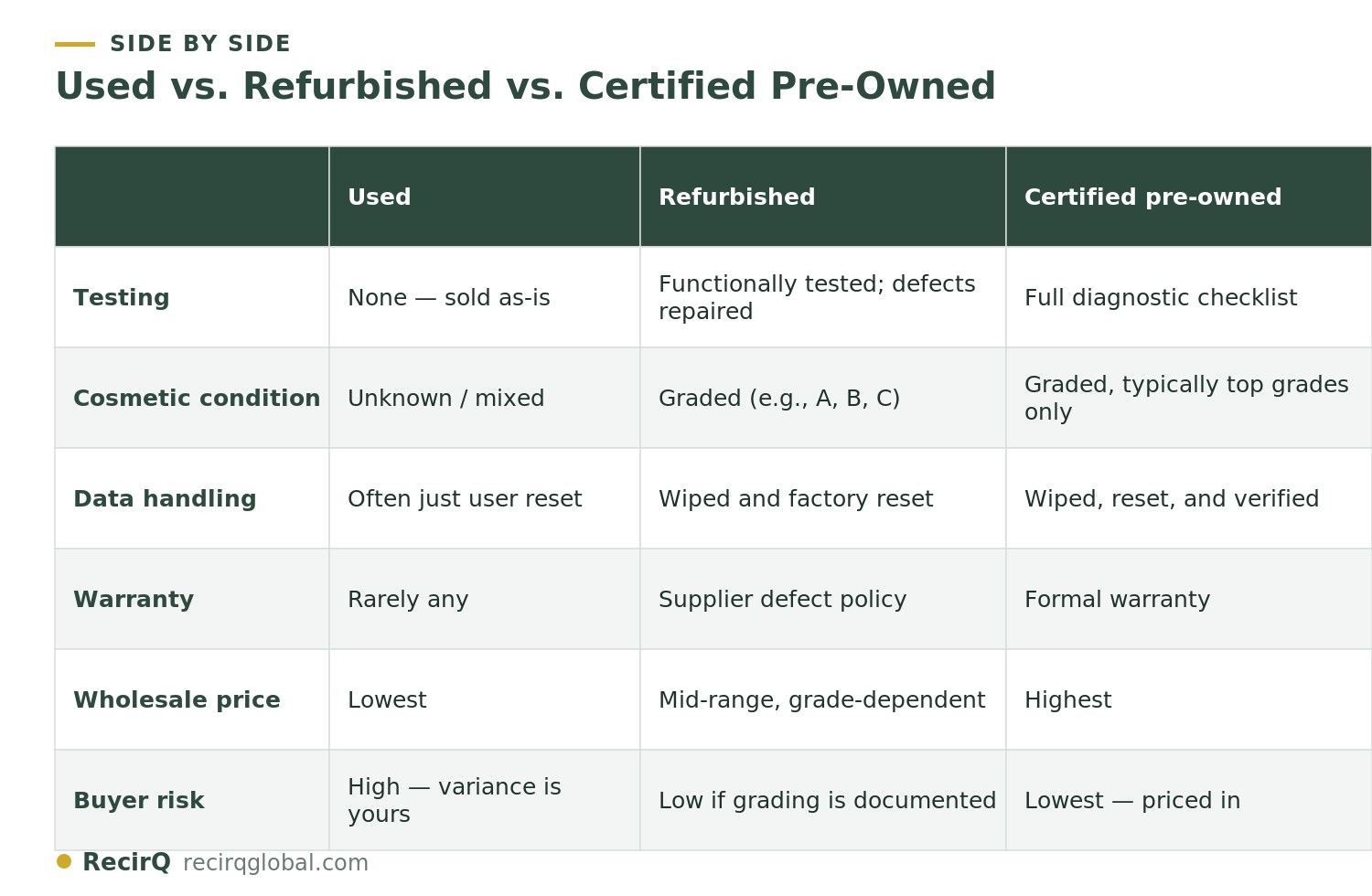
Here's the practical takeaway: at wholesale, grades beat labels. A documented Grade A/B/C system with a published definition tells you the cosmetic condition, functional status, and data handling of every unit in the lot. The words "used," "refurbished," or "certified" on the invoice tell you almost nothing by themselves.
When you evaluate a supplier — for wholesale used iPhones, Samsung Galaxy, or Google Pixel — look past the label and ask:
A supplier that answers all five clearly can call its inventory refurbished, pre-owned, or anything else — you know what you're buying. A supplier that leans on the label instead of the process is asking you to take the risk they didn't.
Generally yes — a genuinely refurbished phone has been tested, wiped, and repaired where needed, while a used phone is sold as-is. But because "refurbished" isn't a regulated term, a well-documented used lot from a transparent seller can beat a vaguely "refurbished" one. Judge the process, not the word.
They overlap heavily. CPO is usually refurbished stock that additionally passed a formal certification checklist and carries a warranty. The distinction is only as strong as the certifier — manufacturer CPO programs are strict; a reseller's self-issued "certification" may add nothing but price.
Not automatically. Most refurbishers replace batteries only below a health threshold, and thresholds vary by supplier and grade. If battery health matters for your market, ask for the supplier's specific policy before ordering.
Because grades carry information the labels don't. "Refurbished" describes a process claim; "Grade B" — under a published standard — describes the actual cosmetic and functional state of the unit you'll receive. Wholesale pricing runs on grades for exactly this reason.
Certified refurbished. Every device is sourced from major U.S. carriers, fully tested, data-wiped, factory reset, checked for activation locks, IMEI-verified, and cosmetically graded A, B, or C against a published standard — so the grade on your order line means the same thing on every pallet.
It depends on your operation. Buy raw used lots only if you can test and repair in-house. Buy graded refurbished stock if you want predictable quality at the best margin — this is the sweet spot for most resellers. Buy CPO when your market pays a premium for warranty-backed devices.
Labels are cheap — documented grading is not. RecirQ ships certified refurbished iPhones, Samsung Galaxy, and Google Pixel devices to 150+ resellers worldwide, every unit tested, wiped, and graded against a standard you can read before you buy.
See live inventory, grades, and pricing at buy.recirqglobal.com — creating a reseller account is free and takes a few minutes. Sign up today and stop paying for labels.